Friday, October 23, 2015

Predicting which African storms will intensify into hurricanes

Hurricanes require moisture, the rotation of Earth, and warm ocean temperatures to grow from a mere atmospheric disturbance into a tropical storm. But where do these storm cells originate, and exactly what makes an atmospheric disturbance amp up full throttle?
Typhoon, satellite view (stock image).


A new study published in Geophysical Research Letters by Tel Aviv University's Prof. Colin Price and his graduate student Naama Reicher of the Department of Geosciences at TAU's Faculty of Exact Sciences finds most hurricanes over the Atlantic that eventually make landfall in North America actually start as intense thunderstorms in Western Africa.
"85 percent of the most intense hurricanes affecting the U.S. and Canada start off as disturbances in the atmosphere over Western Africa," says Prof. Price. "We found that the larger the area covered by the disturbances, the higher the chance they would develop into hurricanes only one to two weeks later."
Watching the clouds gather
Using data covering 2005-2010, Prof. Price analyzed images of cloud cover taken by geostationary satellites, which orbit Earth at the precise speed of Earth's rotation and take pictures of cloud cover every 15 minutes. This enabled Prof. Price to track the variability in cloud cover blocking Earth's surface in West Africa between the months of June and November -- hurricane season.
The coverage of clouds acts as an indication of atmospheric disturbances. The more clouds in an area, the larger the disturbance. Using infrared cloud-top temperature data gathered from satellites, Prof. Price assessed the temperatures of the cloud tops, which grow colder the higher they rise. He then compared his cloud data with hurricane statistics -- intensity, date of generation, location, and maximum winds --from the same period using the National Hurricane Center data base.
"We first showed that the areal coverage of the cold cloud tops in tropical Africa was a good indicator of the monthly number of atmospheric disturbances -- or waves -- leaving the west coast of tropical Africa," said Prof. Price. "The disturbances that developed into tropical storms had a significantly larger area covered by cold cloud tops compared with non-developing waves."
What makes them special
According to Prof. Price, only 10 percent of the 60 disturbances originating in Africa every year turn into hurricanes. And while there are around 90 hurricanes globally every year, only 10 develop in the Atlantic Ocean.
"We wanted to know what was so special about these 10% of disturbances that develop into hurricanes. Was there something different about these storms at their genesis?" said Prof. Price. "By looking at each of these storms individually, we found again that the larger the cloud coverage originally in West Africa, the higher the value of the accumulated cyclone energy in a future hurricane. The conclusion, then, is that the spatial coverage of thunderstorms in West Africa can foretell the intensity of a hurricane a week later.
"If we can predict a hurricane one or two weeks in advance -- the entire lifespan of a hurricane -- imagine how much better prepared cities and towns can be to meet these phenomena head on," Prof. Price says. He is currently examining the thunderstorm clusters around the eyes of hurricanes to study the intensification process of those destructive phenomena.

Ocean heat content reveals secrets of fish migration behaviors Study uses hurricane forecasting tool to show fishes affinity for ocean fronts and eddies

Researchers at the University of Miami (UM) Rosenstiel School of Marine and Atmospheric Science developed a new method to estimate fish movements using ocean heat content images, a dataset commonly used in hurricane intensity forecasting. With Atlantic tarpon as the messenger, this is the first study to quantitatively show that large migratory fishes, such as yellowfin and bluefin tunas, blue and white marlin, and sailfish have affinities for ocean fronts and eddies.
This image shows front and eddy utilization in the Gulf of Mexico by pelagic fishes revealed by ocean heat content: (a) a yellowfin tuna (Thunnus albacares); and, (b) an Atlantic sailfish. OHC maps are based on calculating thermal energy from the depths of the 20°C isotherm.
"Ocean heat content data revealed detailed movements of fishes that were not readily apparent using surface temperature data," said Jerald S. Ault, UM Rosenstiel School professor of marine biology and ecology. "This offers a powerful new approach to study how fish interact with dynamic water features relatively common in the ocean."
Ocean heat content (OHC) relative to the 26°C isotherm, a measure of heat stored in the upper surface layers of the ocean, has been used for more than four decades by scientists to help predict hurricane intensity. Over the past two decades, OHC has been monitored daily using satellite fields and in-situ data that provide basin-scale variability for both weather and climate studies. In addition to providing the OHC for forecasting, these previous studies showed OHC images reveal dynamic ocean features, such as fronts and eddies, in the ocean better than just using standard techniques (e.g., sea surface temperature), especially during the summer months.
The researchers compared data on fish movements obtained from pop-up satellite tags affixed to the highly migratory fish alongside maps of the heat stored in the upper ocean. "Using an advanced optimization algorithm and OHC maps, we developed a method to greatly improve geolocation accuracy and refine fish movement tracks derived from satellite tags," said Jiangang Luo, lead author and UM scientist at the Tarpon and Bonefish Research Center. The analysis revealed that fish commonly swim along the boundaries of water features in the ocean, such as fronts, like the Florida and Loop Current and their complex eddy fields.
"Using the OHC approach in a new way offers an unprecedented view of how these animals move with currents and eddies in the ocean," said Nick Shay, UM Rosenstiel School professor of ocean sciences. "Our study provides a more detailed picture of the ocean ecosystem as an entity."
In one 109-day analysis, the researchers documented a yellowfin tuna move along a weak front off the Mississippi River before reaching an eddy centered in the Gulf of Mexico. In separate analysis, a yellowfin tuna swam around the periphery of the same eddy many times over a 20-day period, rarely passing over it.
Eddies are swirling masses of water that have been shed from strong ocean current fronts, and pump nutrient-rich water to the surface. Fronts are a type of current created at a boundary between two distinct water masses with differing physical properties, such as different temperatures, salinities. In the Gulf of Mexico, warm eddies are often shed from the Loop Current in the summer months causing a rapid intensification of hurricanes (e.g., Katrina) as they pass over it.
"Our new method shows that hurricanes and highly migratory fish share at least one common oceanographic interest -- warm swirling ocean eddies," said Ault

Scientists find link between comet, asteroid showers and mass extinctions

For more than 30 years, scientists have argued about a controversial hypothesis relating to periodic mass extinctions and impact craters -- caused by comet and asteroid showers -- on Earth. Now scientists have concluded that mass extinctions occurring over the past 260 million years were likely caused by comet and asteroid showers.
An artist's illustration of a major asteroid impact on Earth.
Mass extinctions occurring over the past 260 million years were likely caused by comet and asteroid showers, scientists conclude in a new study published in Monthly Notices of the Royal Astronomical Society.
For more than 30 years, scientists have argued about a controversial hypothesis relating to periodic mass extinctions and impact craters -- caused by comet and asteroid showers -- on Earth.
In their MNRAS paper, Michael Rampino, a New York University geologist, and Ken Caldeira, a scientist in the Carnegie Institution's Department of Global Ecology, offer new support linking the age of these craters with recurring mass extinctions of life, including the demise of the dinosaurs. Specifically, they show a cyclical pattern over the studied period, with both impacts and extinction events taking place every 26 million years.
This cycle has been linked to periodic motion of the Sun and planets through the dense mid-plane of our galaxy. Scientists have theorized that gravitational perturbations of the distant Oort comet cloud that surrounds the Sun lead to periodic comet showers in the inner solar system, where some comets strike Earth.
To test their hypothesis, Rampino and Caldeira performed time-series analyses of impacts and extinctions using newly available data offering more accurate age estimates.
"The correlation between the formation of these impacts and extinction events over the past 260 million years is striking and suggests a cause-and-effect relationship," says Rampino.
Specifically, he and Caldeira found that six mass extinctions of life during the studied period correlate with times of enhanced impact cratering on Earth. One of the craters considered in the study is the large (180 km diameter) Chicxulub impact structure in the Yucatan, which dates to about 65 million years ago -- the time of a great mass extinction that included the dinosaurs.
Moreover, they add, five out of the six largest impact craters of the last 260 million years on earth correlate with mass extinction events.
"This cosmic cycle of death and destruction has without a doubt affected the history of life on our planet," Rampino observes.

Formation of coastal sea ice in North Pacific drives ocean circulation, climate

New understanding of changes in North Pacific ocean circulation over the past 1.2 million years could lead to better global climate models

An unprecedented analysis of North Pacific ocean circulation over the past 1.2 million years has found that sea ice formation in coastal regions is a key driver of deep ocean circulation, influencing climate on regional and global scales. Coastal sea ice formation takes place on relatively small scales, however, and is not captured well in global climate models.
The formation of coastal sea ice, seen here in the Arctic Ocean, plays an important role in driving "overturning circulation" in the North Pacific Ocean.
An unprecedented analysis of North Pacific ocean circulation over the past 1.2 million years has found that sea ice formation in coastal regions is a key driver of deep ocean circulation, influencing climate on regional and global scales. Coastal sea ice formation takes place on relatively small scales, however, and is not captured well in global climate models, according to scientists at the University of California, Santa Cruz, who conducted the study.
A paper on the new findings will be published in a future issue of the journalPaleoceanography and is currently available online.
"We have identified an important process that current global climate models don't adequately capture. Coastal sea ice formation may be important to future climate change because the arctic and subarctic regions are warming at twice the rate of other parts of the world," said first author Karla Knudson, a graduate student in Earth and planetary sciences at UC Santa Cruz.
When sea ice forms, it expels salt into the surrounding water, increasing the density of the water and causing it to sink, carrying oxygenated surface water into the depths. One result is a flow of cold deep water toward the equator and warm surface water toward the poles, and this "overturning circulation" plays a crucial role in moving heat around the globe.
"It helps to modulate the climate by transferring heat from the equator to the poles," said coauthor Christina Ravelo, professor of ocean sciences at UC Santa Cruz.
This process (also called "thermohaline circulation") has received less attention in the North Pacific than in the North Atlantic, where the formation of North Atlantic Deep Water is a powerful driver of global ocean circulation and climate. In the North Pacific, overturning circulation driven by formation of the North Pacific Intermediate Water is not as strong as in the North Atlantic, but it plays a major role in the region's climate.
In 2009, when Ravelo led an expedition of the Integrated Ocean Drilling Program (IODP) to the Bering Sea (with co-chief scientist Kozo Takahashi of Kyushu University, Japan), one of her main goals was to investigate the role of the North Pacific Intermediate Water in climate change. The expedition drilled sediment cores from the floor of the Bering Sea that preserve records of the regional climate and ocean circulation covering the past 1.2 million years, much longer than any other oceanographic records from that region. By analyzing these records, Knudson and Ravelo found that the strength of the overturning circulation in the North Pacific is inherently linked to global climate changes, but not in the way scientists had previously thought.
The sediment cores used in this study cover a period when the planet went through many climate cycles driven by variations in Earth's orbit, from extreme glacial periods such as the Last Glacial Maximum about 20,000 years ago, when massive ice sheets covered the northern parts of Europe and North America, to relatively warm interglacial periods with climates more like today's.
Previous studies based on global climate models indicated that the overturning circulation in the North Pacific and North Atlantic responded in opposite ways to major shifts in global climate. During glacial periods, sea level falls as water gets locked up in the ice sheets, and in extreme cases the Bering Strait connecting the Bering Sea to the Arctic Ocean closes and becomes a land bridge. This shuts off the flow of relatively fresh North Pacific water into the saltier North Atlantic, leading to increased salinity in the North Atlantic and stronger overturning circulation there.
At the same time, the thinking went, a fresher North Pacific would have weaker circulation. This oceanic "seesaw" would result in a cooling effect in one ocean and a warming effect in the other. But that's not what the sediment cores revealed. "We found that the overturning circulation actually strengthens in both oceans when the Bering Strait is closed," Knudson said.
What the climate models were missing, she said, was the strong brine production from sea ice formation in the Bering Sea. The global climate models do a good job of simulating the process of sea ice formation over large areas in the open ocean. But the critical coastal process, which actually generates more of the deep water, occurs on smaller scales and is only captured in high-resolution regional climate models, Knudson said.
The Bering Sea is less important during warm periods like today, when wintertime sea ice formation in the Sea of Okhotsk generates most of the North Pacific Intermediate Water. But the same process of sea ice formation and brine production along coastal shelves plays a critical role wherever it occurs.
"These small-scale processes might be important to understanding the full impact of climate change," Ravelo said. "As the climate gets warmer, we could see reduced sea ice formation in the Sea of Okhotsk and the Arctic. So it would be nice for the climate models to have sufficient resolution to be able to predict the impact of changes in coastal sea ice."
Knudson and Ravelo based their findings on an analysis of carbon and oxygen isotopes in the calcium carbonate shells of tiny marine organisms called foraminifera, which are preserved in seafloor sediments. Chemical signatures of the ocean water the organisms lived in are locked into the composition of their shells, and researchers can analyze them for evidence of past water temperatures and other oceanographic conditions.

Robot School Opens, Addresses Environmental Challenges

The National Oceanography Center (NOC) is a partner in a new $3.8m Center for Doctoral Training in the use of 'robotic' systems for environmental sciences.
Photo courtesy of NOC

The NOC component of the center will focus on innovative marine robotics and sensors, which can be used to address key scientific challenges such as; climate change, deep-sea exploration, and identification of biodiversity ‘hotspots’. The fleet of marine robots based at the NOC has recently developed into one of the most advanced in the world.

This project is being led by the University of Southampton, and also involves the British Antarctic Survey, Heriot-Watt University, University of East Anglia, and the Scottish Association for Marine Science. Between all six organizations, this school will teach skills in a range of unmanned systems - which can monitor everything from erupting volcanoes to algal blooms in the ocean. 

Kevin Forshaw, Director of Enterprise and Impact at the NOC, said: “By teaching students the knowledge and skills the marine autonomy sector urgently needs, this training centre is part of the NOC's ongoing program of supporting business. This sector is currently valued at $13.8 bn and is rapidly expanding.”

The center is called NEXUSS (NEXt generation Unmanned Systems Science), and is funded by the Natural Environment Research Council (NERC) and the Engineering and Physical Sciences Research Council (EPSRC). It will provide training to over 30 science and engineering PhD students, with the first intake due to start in autumn 2016.

Sunday, October 18, 2015

‘Banned’ herbal drink makes a return ‘Banned’ herbal drink makes a return

When Musimboti nyama herbal drink took Zimbabwe by storm just after the turn of the millennium, it caused quite a stir and proponents of traditional alternative therapy went into an overdrive.
By Phyllis Mbanje
They claimed that the “miracle” drug could cure cancer, HIV and Aids and a host of other chronic ailments.
There was a frenzied rush for the drink which could be accessed from leading supermarkets.
The ailing and those who just wanted to prop up their immune system gouged themselves on the golden coloured concoction.
However, regulatory body Medicines Control Authority of Zimbabwe (MCAZ) banned the drink and ordered that it be withdrawn from the shelves.
For the next 14 years there was a protracted battle between the MCAZ and Musimboti makers.
The dispute later dragged in the Traditional Medical Practitioners Council (TMPC) which registered Musimboti.
The TMPC argued that MCAZ had no mandate to regulate traditional medicine.
Manufacturers of Musimboti, (which means essential), said the drink was not a medicine but a herbal immune booster.
But the regulatory body insisted that medicines or complementary medicines that were manufactured on a commercial scale for sale to the public must meet the standards of manufacture of any other medicine.
An old promotional material for Musimboti, herbal products read: “Try our Musimboti sweet drink for the whole family and start seeing the benefits and also go ahead and get our different products for ladies and men from skin conditions, to sexual health, to literally barrenness and all other issues we face health-wise. Try Musimboti today.”
Early this year the Musimboti brand reappeared once again.
Musimboti Traditional Science Institute operations manager Newton Mudzingwa could not be drawn to comment on whether the hatchet with MCAZ had been buried and chose instead to promote his products.
He said traditional knowledge was amassed and passed from generation to another and prior to tablets and injections, there were no diseases such as high blood pressure and diabetes.
Musimboti Traditional Science Institute, a member of the Aids Services Institute headquartered in Kamfinsa, Greendale, sells products like immune boosters and modulators.
“We treat all infections affecting the general body using detoxification or cleansers. Most important, we also manage and treat all types of cancers,” Mudzingwa said.
The institute also claims to treat women’s diseases, paying attention to period pains, irregular bleeding, infertility and fibroids.
For men, it claims to tackle erectile dysfunction, low libido and prostate cancer without an operation.
Mudzingwa said while treatment of cancer was very expensive in hospitals, he could do the same for $500 only, depending on the stage.
“We treat cancer which is traditionally known as nhuta or gomarara or invukuzane in Ndebele.
Mudzingwa said cancer is curable based on the behaviour of the mole [nhuta].
The way the mole behaves inside the soil is similar to how it behaves in the human body.
“Many people do not believe in their traditional medicines, they prefer to use the western types of medicine and approaches which include chemotherapy, radiotherapy and surgical procedures which make the cancer very much aggressive and it spreads faster after the procedures,” he explained.
The herbalist said society had to change its attitude towards traditional medicines and approaches to treatment.
“The medical side needs to move with time and give patients the opportunity to choose the type of care they want,” said Mudzingwa.
A MCAZ spokesperson said Musimboti’s case was yet to be considered and that following the gazetting of the complementary medicines, all sticky issues would be resolved.
“Previously there was no legislation that was specific to address such matters but now we do,” he said
Read more;

Habitat Loss and Degradation

Every living thing needs somewhere to live, find food and reproduce. This is known as its habitat. In order for a species to be viable its habitat must have sufficient territory, necessary food and water and a range of necessary physical features. These features can include tree cover, rocky hills or deep pools, as well as the organisms and ecosystems that are needed to complete the life cycle.
Habitat loss is when land cover, or i
Habitat Loss and Degradationts aquatic equivalent, is changed, usually as a result of changing use by humans. Whenever we humans take over natural areas for our own use, we are encroaching on the habitat of another creature and progressively we are doing this at an alarming rate.
The world's forests, swamps, lakes and other habitats continue to disappear as we make way for agriculture, housing, roads, pipelines and all the other hallmarks of industrial development.
Human activity is responsible for the loss of around half of the forests that once covered the Earth. Although these can recover and can even be sustainably harvested, their rate of loss is about ten times higher than the rate of regrowth.
Europe's wetlands are traditionally an important habitat for countless numbers of creatures, but around 60% have been damaged, even though they are often an essential provider of clean drinking water.
Taking just one example: because of rainforest habitat loss it is estimated that at least 120 out of the 620 living primate species (apes, monkeys, lemurs and others) will be extinct within the next 10 to 20 years.
Habitat loss is generally more serious for the larger animals because they need a greater area in which to have a healthy breeding population. Tigers, mountain gorillas, pandas and Indian lions are good examples, but habitat loss does not just affect animals.
A recent study has indicated that more than 40 species of fish currently found in the Mediterranean could disappear in the next few years. Tropical orchids that thrive in the rain forests are at serious risk as are numerous species of birds from a wide variety of habitats. In fact the only species that are not truly affected by habitat loss are creatures that benefit from human activity such as cockroaches and rats.
The International Union for Conservation of Nature and Natural Resources (IUCN) has a Red List of species officially classified as ''Threatened'' or ''Endangered''. Habitat loss has been identified as being the main threat to 85% of these.
Habitat loss is also a huge problem in the marine environment. Destructive fishing, using deep trawlers and dynamiting coral reefs destroy entire ecosystems. Coastal habitats are destroyed when land is drained for development. Excess nutrients from fertilisers or domestic sewage flow into the sea, causing harmful algae to form, blocking out the sunlight and depleting the water of oxygen.
Pollution from toxic substances such as industrial chemicals, pesticides and motor oil are also a real problem. Dredging ship channels will stir up accumulated sediments and pollutants and the removed material is often dumped on salt marshes, destroying the habitats of the creatures that live there.
Accidents at sea have also had a profound effect on habitat destruction. Several large oil tankers have been involved in major spills, and of course there was the Deepwater Horizon oilrig disaster in the Gulf of Mexico. In each case, enormous quantities of oil have been released into the ocean, devastating the entire ecosystems of the area.
Diversity loss is yet another feature of habitat degradation. A particular ecosystem is home to a number of species and as these begin to go into a rapid decline following the loss of their habitat, a more aggressive species might take the opportunity and move in. As the original species struggle to survive in an increasingly hostile environment, the aggressive invader causes further decline until it eventually reigns supreme.
The proliferation of invasive species poses a strong threat to native species as they struggle to cope with highly fluctuating environments. In order to mitigate diversity loss, it is important for conservation efforts to focus on reducing the numbers of invasive species.
The world is getting warmer and climate change has already had, or is expected to have, a serious influence on habitat loss. Many former habitats have already become inhospitable. Plants that thrive in damp, cool conditions now simply wither and die during prolonged dry periods.
A study in Nature indicated that within the next 50 years a quarter of the world's land animals and plants could become extinct. This is around a million species.
In the UK, as sea levels rise, marshland close to river estuaries would disappear. The loss of inland wet grassland and coastal sea marsh would lead to the loss of breeding habitats of birds such as the redshank. A continued rise in level would mean the loss of feeding areas needed by waders and other shore birds.
Still in the UK, trees such as the oak and the ash would find it difficult to survive frequent prolonged droughts. Wetland areas that are home to rare moths and other creatures would simply dry out. Warm hot summers also encourage algae to flourish on rivers and lakes, at the expense of fish and bird life.
Milder winters will allow the survival of pests and bacteria that cold weather would formerly have eradicated. This will have a serious effect on crops and wildlife. Thin soils will dry out and erode in summer and flash floods will cause more soil to be washed away.
Rapidly changing weather patterns will also disrupt growing patterns. In parts of the world where rainfall is already scarce, as in parts of Africa and China, crop failure and subsequent famine will become a real danger.
Extreme weather events are increasingly occurring as a result of climate change. These events can be enormously destructive and have a disastrous effect on habitat, since they are often associated with high winds or floods.
We are fortunate to be part of a world that is characterised by the diversity of its many species of plant and animal life. Countless numbers of these species are under threat of extinction, mainly through loss of habitat. The chief reasons for this loss are human intervention and climate change.
The world is already warming and although there is little that can be done about it, we can slow the process down by reducing the amounts of greenhouse gas currently being released into the atmosphere and concentrating more on energy saving measures and renewable energy systems
We are all jointly responsible for the world around us. If mankind can be persuaded to be more environmentally aware of the responsibility to safeguard the habitats of these endangered creatures, there is yet some hope for their survival.


Read more at http://www.earthtimes.org/encyclopaedia/environmental-issues/habitat-loss-degradation/#qHJFtUD7lLwhkpZW.99

Waste

During the year 2008/2009, 37% of UK household waste was recycled, compared to only 14% in 2000/2001 and during that period the amount sent to landfill fell from 78% to 50%. According to DEFRA (Department of Environment, Food and Rural Affairs) waste management accounted for an estimated 3.6% of the UK's green house emissions during 2008. 89% of this came from landfill, 9% from wastewater handling and 2% from waste incineration.
Vast amounts of domestic and industrial waste are generated each year and landfill remains a common means of waste disposal in most countries. Traditionally this was simply dumped into holes in the ground and sites were located in former quarries, mining voids or borrow pits.
Waste
If properly designed and well managed, landfill can provide a hygienic and relatively inexpensive method of waste disposal. On the other hand, poorly designed or poorly managed landfill sites can create wind blown litter, attract vermin and allow contamination to leach into the soil. In addition as the waste breaks down methane and carbon dioxide are produced, which are greenhouse gases and can cause odour problems and kill surface vegetation.
These problems can largely be overcome by lining the pit with clay to prevent leaching; compacting the waste to increase density and stability; covering the material to prevent attracting rats and mice; and installing gas extraction systems.
In spite of this, landfill is becoming more controversial, partly due to the ever-decreasing number of suitable sites, but largely for the fact that it encourages the dumping of materials that could be reused or recycled.
People are beginning to look for other solutions and attention is turning to ways in which all this waste can be put to good use. Incineration of waste has always been fairly common in a domestic context, but it is also carried out on an industrial scale. It is useful for disposing of residue of both solid waste management and solid residue from wastewater management. The process reduces volumes of solid waste to between 20% and 30% of its original volume.
Incineration can be used for the disposal of solid, liquid and gaseous waste and is recognised as being a practical method of disposing of certain hazardous waste materials such as biological medical waste.
It is a particularly common method of waste disposal in highly populated countries such as Japan where land is scarce. Again, this is a controversial means of waste disposal. Often these incineration furnaces are used to generate, heat, steam or electricity, but combustion is not always perfect and there is concern about the emission of gaseous pollutants and the harm that they might do to the environment.
Recycling can be a very cost-effective way of disposing of waste materials by collecting them for reprocessing into new products. Many items of domestic and industrial waste can be recycled. Aluminium from beverage cans, steel food or aerosol cans, copper wire, old cars, plastic bottles, glass bottles, scrap paper, newspapers, magazines and cardboard are just some examples.
Materials such as glass, steel and aluminium can be recycled an infinite number of times and reprocessed using a fraction of the amount of energy that is needed to create a new product. It should be pointed out that if glass is put in landfill it will take about 4,000 years to break down.
Computers and electronic equipment can also be recycled, but this usually involves painstaking dismantling. For this reason, combined with lack of regulation, this type of e-waste (ewaste or electronic waste), is often shipped to developing countries where labour costs are lower; much of it ending up in large e-waste dumps.
Biological reprocessing of waste is really another name for composting, where the aim is to recycle material to produce a mulch or compost for agricultural or landscaping purposes. Quite often the waste gas, such as methane, that is generated as part of the process will be captured and used for generating electricity or heat, thus maximising efficiencies.
Composting is very common in the domestic situation and has been popular with generations of gardeners, where vegetable matter such as garden waste is rotted down on the traditional compost heap.
Anaerobic digestion is the next step. Each year the UK produces 100 million tonnes of waste suitable for anaerobic digestion. Most of this, 80 to 90 million tonnes, is made up of manures and slurries, but 12 to 20 million tonnes is food waste.
It is estimated that by 2020 this could generate at least 10 to 20 TWh (terawatt hours - thousand million kilowatt hours) of heat and electricity per year, or 27 TWh if converted into biomethane for injection into the gas grid. Putting this into perspective, 27 TWh represents about 7% of current UK domestic gas demand.
It is also suggested that this gas could be further refined to produce hydrogen for use in stationary cogeneration fuel cells. If used in this way it would eliminate the pollution from products of combustion.
In the UK 66% of sewage sludge is already treated by anaerobic digestion and in 2008 this produced 0.7 TWh of electricity.
A further bonus of anaerobic digestion is that diversion of biodegradable waste from landfill can achieve a significant reduction in greenhouse gas emissions. Capturing biogas from one tonne of food waste will save the equivalent of 0.5 to 1 tonne of carbon dioxide.
Waste products always contain energy and this can be harnessed either by using them as direct combustion fuel or indirectly by processing them into another kind of fuel. Anaerobic digestion is an excellent example of this indirect process.
In the years of plenty our society became a ''throw away'' society; when something broke or wore out it was simply thrown away. An important part of waste management is to prevent the creation of such waste material. This includes repairing broken items rather than simply replacing them with new ones; reusing cotton shopping bags rather than using throwaway plastic ones; avoiding the use of disposable products and designing products that use less material while serving the same purpose, such as lightweight drink cans and bottles.
The cornerstone of most waste management strategies is the waste hierarchy, also known as the ''3 Rs'' - reduce, reuse, recycle. The aim is to extract the maximum practical benefit from products and to generate the minimum amount of waste.
It can be compared to a six-layer pyramid.
  • At the peak is the ultimate aim - the prevention of waste.
  • The next layer is minimisation, where you generate as little waste as possible.
  • Below this is reuse, where you repair rather than throw away.
  • The next layer is recycling where waste materials are processed into new products.
  • Fifth from the top is energy recovery where energy is extracted from remaining waste.
  • Finally, the bottom line, the disposal of anything that is left.

    Various strategies have been considered to deal with waste. Producer responsibility is a strategy designed to promote the integration of all costs associated with a product up to its eventual disposal. Manufacturers, importers or vendors of a product are required to be responsible for its end-of-life disposal. The costs of this would obviously be reflected in the purchase price.
    Another strategy is the polluter pays principle. In this case the polluting party is responsible for paying for the impact caused to the environment. With respect to waste management, this will generally mean being required to pay for appropriate disposal of waste.
    An example of this principle would involve the kerbside collection vehicle weighing each bin as it was being emptied and the consumer subsequently being billed accordingly.
    One of the most critical issues with respect to waste management is education and awareness. The world's natural resources are in grave danger. Environmental pollution and degradation are occurring at an unprecedented scale and speed.
    Waste material represents a fantastic resource that in many cases is simply there waiting to be tapped. To simply bury it in the ground or burn it is not a realistic option in the 21stcentury.


  • Read more at http://www.earthtimes.org/encyclopaedia/environmental-issues/waste/#DvwHmXVyPTBfyE8A.99

    Mass Extinction

    The formation of the Earth occurred some 4.6 billion years ago but it was only in the last 570 million years that the first familiar life forms began to evolve. These were arthropods and were followed 40 million years later by the first fish. The first land plants began to appear around 475 million years ago, with the first forests appearing 90 million years later
    Dinosaurs began to evolve around 225 million years ago and effectively ruled the world before suddenly becoming extinct 160 million years later. Our species, Homo sapiens, have only inhabited the Earth for the last 200 thousand years.
    Most people will know of the mass extinction that saw the end of the dinosaurs, but many will not realise that this was actually the fifth such event in the Earth's history.
    Mass Extinction
    The first occurred around 440 million years ago at the end of the Ordovician when a period of relatively severe and rapid global cooling caused such a pronounced change in marine life that 25% of families were lost.
    The second came around 370 million years ago near the end of the Devonian Period. Again this was possibly the result of climate change and this time 19% of families were lost.
    Around 245 million years ago at the end of the Permian period came the third major extinction when 54% of families were lost. Various theories exist as to why this should have occurred. It has long been felt that it was the result of climate change brought about by tectonic plate movement, but recent evidence suggests some form of extraterrestrial impact.
    The fourth major extinction came at the end of the Triassic Period around 210 years ago. This was shortly after dinosaurs and mammals had first evolved. 23% of families were lost at this time and speculation continues as to the cause.
    So we come to the fifth major extinction that occurred 65 million years ago. Speculation continues among scientific circles as to the exact reason for this. The general consensus is that it was the result of a catastrophic collision between the Earth and one or more extraterrestrial bodies such as a comet, but other scientists believe that it was caused by a great volcanic event. In either case it is thought that debris blotted out the sun's rays, causing disruption to the world's climate and ecosystem.
    Virtually no large land animals survived, plants were greatly affected and tropical marine life was decimated.
    These events illustrate the vulnerability of the world and there is concern that we are now in the middle of the its sixth mass extinction. The difference between this one and the previous five is that this one is the result of human activity.
    Some scientists maintain that this latest mass extinction began when the first modern humans began to disperse to different parts of the world around 100,000 years ago, but the rot really set in when they turned their attention to agriculture around 10,000 years ago. It was agriculture that brought about the most profound ecological change since life on Earth first began. Humans no longer had to interact with other species in order to survive and were able to manipulate them for their own use.
    As long ago as 1993 Harvard biologist E.O.Wilson was estimating that the Earth was losing around 30,000 species per year, which equated to about one species every 20 minutes.
    Thousands of creatures are now endangered and appear on the so-called Red List of Endangered Species. A survey revealed that at least 1,141 of the world's 5,487 mammals, including marine mammals, are facing extinction and at least half are in decline. One in three amphibians and one in five reptiles is fighting for survival.
    Loss of habitat and degradation by agriculture and deforestation affects 40% of the world's mammals. Over harvesting is wiping out larger mammals. This is a frightening sign of what is happening to the ecosystems of the land where they live.
    Many creatures have been lost for ever as a result of human action in what shows every sign of being the world's sixth mass extinction. There is still time to reverse this trend. Swift international action is necessary if we are not to wipe out many of our closest relatives.


    Read more at http://www.earthtimes.org/encyclopaedia/environmental-issues/mass-extinction/#W6AHfrGC8wZ0zG3R.99

    Causes of Climate Change

    Earth's temperature depends on the balance between energy entering and leavingthe planet’s system. When incoming energy from the sun is absorbed by the Earth system, Earth warms. When the sun’s energy is reflected back into space, Earth avoids warming. When absorbed energy is released back into space, Earth cools. Many factors, both natural and human, can cause changes in Earth’s energy balance, including:
    These factors have caused Earth’s climate to change many times.
    Scientists have pieced together a record of Earth’s climate, dating back hundreds of thousands of years (and, in some cases, millions or hundreds of millions of years), by analyzing a number of indirect measures of climate such as ice cores, tree rings, glacier lengths, pollen remains, and ocean sediments, and by studying changes in Earth’s orbit around the sun. [2]
    This record shows that the climate system varies naturally over a wide range of time scales. In general, climate changes prior to the Industrial Revolution in the 1700s can be explained by natural causes, such as changes in solar energy, volcanic eruptions, and natural changes in greenhouse gas (GHG) concentrations. [2]
    Recent climate changes, however, cannot be explained by natural causes alone. Research indicates that natural causes do not explain most observed warming, especially warming since the mid-20th century. Rather, it is extremely likely that human activities have been the dominant cause of that warming.

    The Greenhouse Effect causes the atmosphere to retain heat

    When sunlight reaches Earth’s surface, it can either be reflected back into space or absorbed by Earth. Once absorbed, the planet releases some of the energy back into the atmosphere as heat (also called infrared radiation). Greenhouse gases (GHGs) like water vapor (H2O), carbon dioxide (CO2), and methane (CH4) absorb energy, slowing or preventing the loss of heat to space. In this way, GHGs act like a blanket, making Earth warmer than it would otherwise be. This process is commonly known as the “greenhouse effect.”
    Role of Greenhouse Gases - Greenhouse gases in the atmosphere absorb much of the long-wave energy emitted from the Earth's surface, preventing it from immediately escaping from the Earth's system. The greenhouse gases then re-emit this energy in all directions, warming the Earth's surface and lower atmosphere.
    This slideshow explains the Greenhouse Effect, among other topics.

    The Role of the Greenhouse Effect in the Past

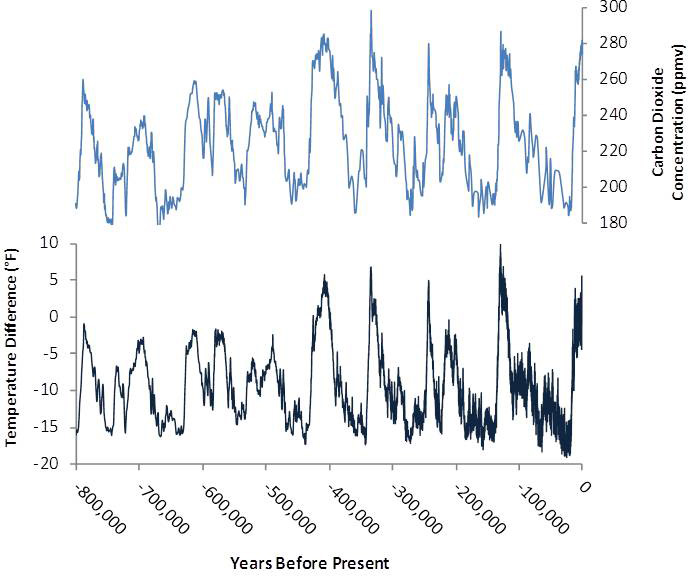
    Over the last several hundred thousand years, CO2 levels varied in tandem with the glacial cycles. During warm "interglacial" periods, CO2 levels were higher. During cool "glacial" periods, CO2 levels were lower. [2] The heating or cooling of Earth’s surface and oceans can cause changes in the natural sources and sinks of these gases, and thus change greenhouse gas concentrations in the atmosphere. [2] These changing concentrations are thought to have acted as a positive feedback, amplifying the temperature changes caused by long-term shifts in Earth’s orbit. [2]
    Line graph with two stacked lines. The top line shows Carbon Dioxide concentration from 800,000 years ago to the present. The bottom line shows the temperature difference in Fahrenheit over the same period. The peaks and dips in both the temperature difference and carbon dioxide concentration are extremely similar.


    Estimates of the Earth’s changing carbon dioxide (CO2) concentration (top) and Antarctic temperature (bottom), based on analysis of ice core data extending back 800,000 years. Until the past century, natural factors caused atmospheric CO2 concentrations to vary within a range of about 180 to 300 parts per million by volume (ppmv). Warmer periods coincide with periods of relatively high CO2 concentrations. NOTE: The past century’s temperature changes and rapid CO2 rise (to 396 ppmv in 2013) are not shown here. Increases over the past half century are shown in the Recent Role section
    Source: Based on data appearing in NRC (2010)